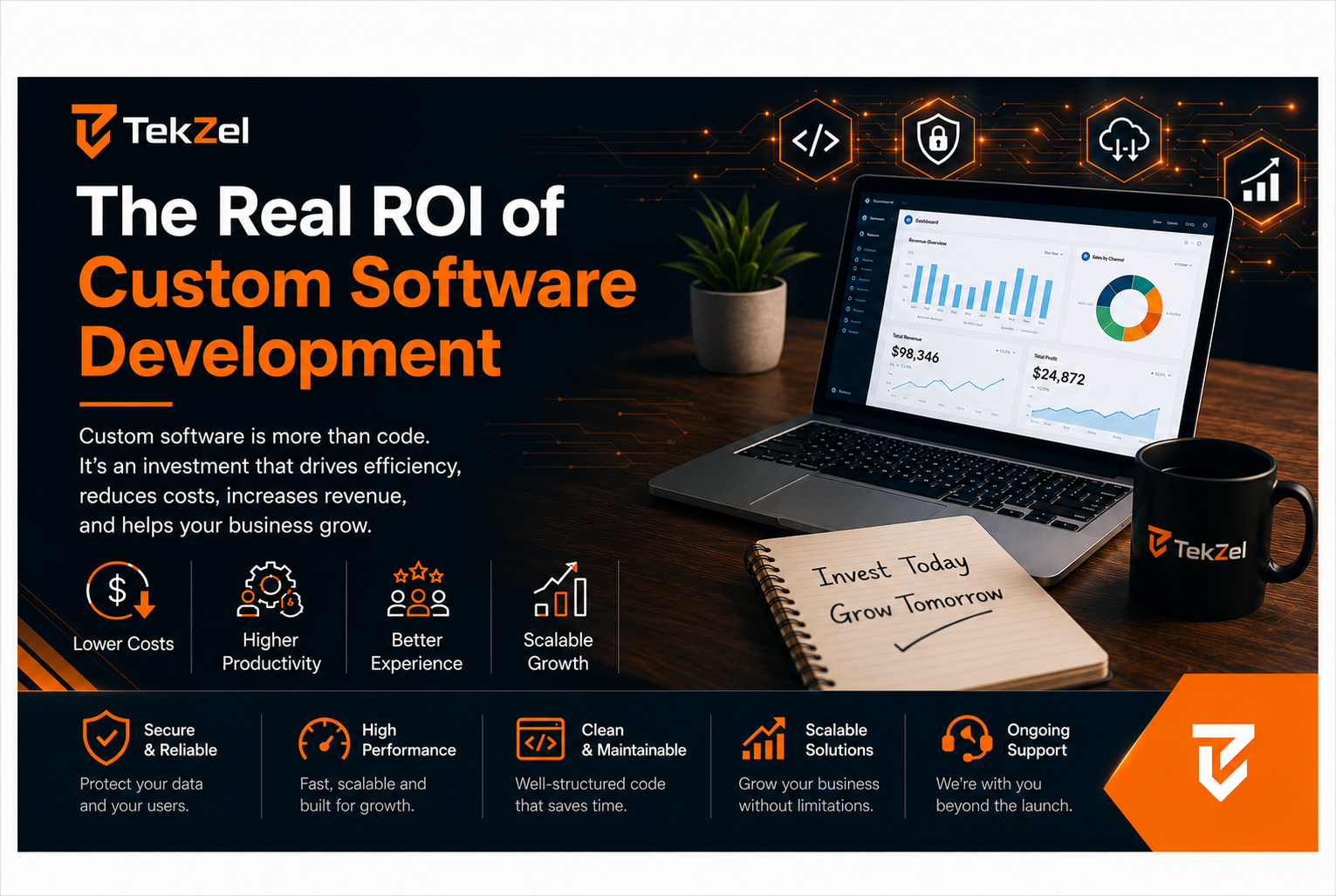
For many business owners, custom software development initially appears to be a significant expense. Compared to off-the-shelf software, the upfront investment can seem higher, leading many companies to delay or avoid custom solutions altogether.
However, focusing only on the initial development cost often overlooks the bigger picture.
The real question isn't "How much does custom software cost?" It's "How much value will it create over the next five to ten years?"
The businesses achieving the greatest long-term success understand that software isn't merely an expense—it's an investment that generates measurable returns through improved productivity, reduced operational costs, enhanced customer experiences, and scalable growth.
Understanding ROI in Software Development
Return on Investment (ROI) measures the financial value generated compared to the amount invested.
A successful software project doesn't simply recover its development cost. It continues creating value long after deployment by helping businesses operate more efficiently, automate repetitive work, reduce errors, and unlock new revenue opportunities.
Instead of measuring software solely by its purchase price, organizations should evaluate:
- Time saved
- Revenue growth
- Reduced operating expenses
- Improved customer satisfaction
- Better employee productivity
- Scalability
- Competitive advantage
These factors collectively determine the true ROI of custom software.
1. Increased Productivity Through Automation
One of the fastest ways custom software generates ROI is by eliminating repetitive manual work. Many businesses still spend countless hours every week on tasks such as:
- Copying data between systems
- Updating spreadsheets
- Preparing reports
- Processing invoices
- Managing customer records
- Approving workflows
Custom software automates these repetitive activities. Employees spend less time performing administrative tasks and more time focusing on revenue-generating work.
Even saving just one hour per employee each day can translate into hundreds of productive hours every month.
2. Lower Long-Term Operating Costs
Many companies underestimate how much they spend on multiple software subscriptions. Businesses often pay separately for:
- CRM software
- Project management tools
- Accounting systems
- Inventory management
- Customer support platforms
- Reporting software
While each subscription may appear affordable individually, together they become a substantial ongoing expense.
A custom platform can integrate multiple business functions into one centralized system, significantly reducing recurring software licensing costs.
3. Better Customer Experience
Customers expect fast, reliable, and seamless digital experiences. Slow applications, confusing workflows, and outdated interfaces lead to:
- Lower customer satisfaction
- Higher abandonment rates
- Lost sales
- Negative reviews
Custom software is designed specifically around your customers' needs. This results in:
- Faster performance
- Personalized experiences
- Streamlined purchasing
- Better support
- Higher customer retention
Satisfied customers naturally generate greater long-term revenue.
4. Software That Grows With Your Business
Many companies eventually outgrow off-the-shelf software. Initially, it may work perfectly. Then business expands. More customers. More employees. More locations. More data. Eventually the software becomes a bottleneck.
Custom software is designed with scalability in mind, allowing businesses to grow without constantly replacing their systems. Avoiding expensive software migrations creates significant long-term savings.
5. Improved Decision Making Through Better Data
Business leaders make better decisions when accurate information is available. Custom dashboards provide real-time visibility into:
- Sales performance
- Customer behavior
- Operational efficiency
- Financial performance
- Team productivity
- Inventory
- Marketing campaigns
Instead of collecting data manually from multiple platforms, executives can access everything from one dashboard. Better information leads to better decisions—and better decisions increase profitability.
6. Stronger Security Reduces Risk
Cybersecurity incidents are becoming increasingly expensive. Poorly secured software can result in:
- Data breaches
- Regulatory penalties
- Lost customer trust
- Downtime
- Financial losses
Professional custom software incorporates:
- Secure authentication
- Role-based permissions
- Data encryption
- Regular updates
- Security monitoring
Preventing a single security incident may justify the entire investment.
7. Competitive Advantage
Every business has unique workflows. Generic software forces companies to adapt their processes. Custom software does the opposite. It adapts to the business.
This enables companies to:
- Serve customers faster
- Deliver better experiences
- Automate unique workflows
- Launch new services
- Respond to market changes more quickly
These competitive advantages compound over time.
8. Easier Integration Across Business Systems
Modern businesses rely on many connected platforms. Examples include:
- ERP
- CRM
- Accounting
- Payment gateways
- HR systems
- Marketing automation
- AI services
Custom software integrates these systems into a unified workflow. Benefits include:
- Reduced manual entry
- Fewer mistakes
- Faster processes
- Better reporting
- Improved operational efficiency
Calculating the ROI of Custom Software
Although every organization is different, businesses can estimate ROI by evaluating:
Annual Savings:
- Labor savings
- Reduced subscription costs
- Lower maintenance expenses
- Fewer operational errors
Revenue Growth:
- Increased conversions
- Higher customer retention
- Faster sales cycles
- New digital services
Risk Reduction:
- Improved security
- Reduced downtime
- Better compliance
- Lower support costs
When these factors are combined, many organizations recover their software investment within a relatively short period while continuing to benefit for years afterward.
When Does Custom Software Make Sense?
Custom software is an excellent investment if your business:
- Has unique operational workflows
- Uses multiple disconnected systems
- Experiences rapid growth
- Requires advanced reporting
- Needs automation
- Handles sensitive customer data
- Wants to improve customer experience
- Plans for long-term scalability
Why Businesses Choose TekZel
At TekZel, we believe software should deliver measurable business outcomes—not simply meet technical requirements.
Our team designs secure, scalable, and high-performance custom software solutions that help startups, SMEs, and enterprises improve efficiency, reduce costs, and accelerate digital transformation.
Whether you're building a customer portal, SaaS platform, enterprise application, AI-powered solution, or cloud-native system, we focus on maximizing long-term business value from day one.
Final Thoughts
Custom software development isn't just about replacing manual processes or modernizing outdated systems.
It's about building a competitive advantage that continues generating value year after year.
When evaluated over the long term, the return on investment often extends far beyond financial savings. Businesses benefit from improved efficiency, better customer experiences, stronger security, enhanced scalability, and sustainable growth.
The question is no longer whether custom software costs more upfront.
Can your business afford the long-term cost of not investing in software built specifically for your growth?